Unseen Reaping Shades
New Life as a Max Level ArchmageUnseen Reaping Shades are defined by extreme elusiveness rather than by a formidable level alone. Their pelts are so rare that even a specialist with access to private channels has encountered only two recorded listings, while sightings occur merely a few times a year. Their scarcity makes the three freshly harvested pelts obtained by Vivisari Vexaria’s daughter the crucial proof of an otherwise nearly unbelievable hunt and the foundation of an exceptional piece of armor.
Elusiveness and Threat
An Unseen Reaping Shade can disappear from every ordinary avenue of detection. According to Rhek Verontell, the creature stops existing when someone looks at it, hears it, or senses it, whether through magic or conventional perception. The apparent vanishing is more precisely a process of decorporealization followed by teleportation, leaving only a brief interval in which certain attacks can still connect. Survival therefore depends on recognizing and exploiting an instant that the creature’s own nature seems designed to erase.
That evasiveness produces a distinctive form of danger: the creature is difficult to locate precisely because detection itself announces that the encounter is already nearly over. The account places the threat in a narrow gap between anticipation and bodily violence. If someone hears or sees an Unseen Reaping Shade, disembowelment may follow within roughly three seconds. Despite their low level, they are described as nasty monsters, so conventional assumptions about level and danger fail against them.
The Three Pelts
Rhek’s astonishment centers on three Unseen Reaping Shade pelts lying together on his worktable. He regards the number as almost impossible, not merely because the creatures are difficult to kill but because finding even one is close to an event of exceptional rarity. The pelts are not old trophies or uncertain remains: his skills confirm that all three were harvested within the past several hours, as were the other rare materials assembled for the commission.
Vivisari Vexaria’s daughter explains that she knew the hunting zones of the Central Kingdom and used divination spells to locate suitable targets. She also identifies the creature’s tactical weakness, explaining that decorporealization and teleportation leave a short window in which particular attacks remain effective. Her explanation turns the hunt from an impossible boast into a technically coherent account, but it does not make the achievement ordinary. Rhek’s professional judgment still places the feat beyond what almost anyone could have accomplished; he concludes that nobody short of an upper-Titled could plausibly have arranged such a collection, and the fresh pelts finally extinguish his remaining doubts about her identity as the Sorceress’s daughter.
Material in the Armor Project
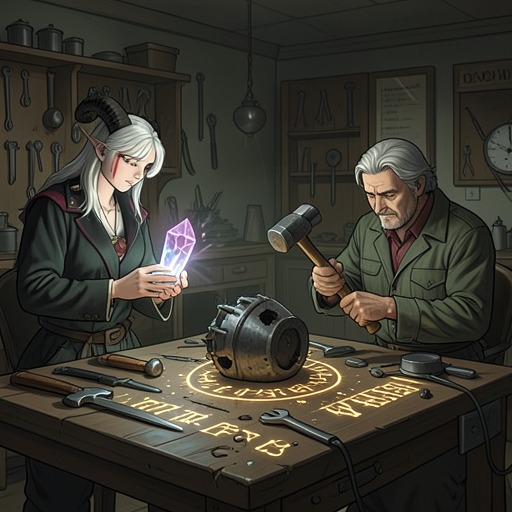
The pelts become the central material in the collaborative crafting project that produces the Heartguard of the Fleeting Shade. Rhek handles the pelts with a fleshing knife while the mage prepares the supporting materials, including Wyrmwood Ash, Owlbear fat, and the shell of a Crystalback Goliabeetle. The mage’s abilities accelerate processes that would normally take days: she reduces Wyrmwood Ash into concentrated tanning liquor, and the pelts darken within minutes as they pass through successive vats.
Once the hides are ready for stitching, she lays enchantments into them before the armor is formed. That timing matters because pre-formation enchantment can improve quality when the enchanter outranks the principal craftsman. Rhek, already a Master Leatherworker, recognizes that the project has been transformed by a collaborator whose rank and abilities remove several stages of ordinary labor. The creatures therefore matter not only as dangerous quarry but also as a material challenge whose rarity and properties allow the finished equipment to exceed normal expectations.
The Heartguard of the Fleeting Shade
The completed cuirass is identified as the Heartguard of the Fleeting Shade, a Transcendent item at level 385. Its four matching pieces withstand Rhek’s ordinary durability tests far beyond the listed requirement. The gear rebuffs tests at level 450, then 500, and continues to resist until level 650, the mithril-rank threshold at which it finally begins to show stress.
This result makes the Unseen Reaping Shade pelts the source of a striking contradiction: armor commissioned with silver-rank expectations possesses durability comparable to mithril-rank equipment. The appearance remains more distinctive than the client wanted because of the pelts’ coloration and character, although she accepts responsibility for choosing them and credits Rhek with preventing them from standing out even more. Their visual difference is thus a visible reminder of the creatures’ unusual material identity, while their practical contribution is concealed inside armor whose performance overturns Rhek’s understanding of what the ranking system permits.
Narrative Significance
The Unseen Reaping Shades function as a test of knowledge, perception, and professional credibility. Their threat is established through the danger of being noticed, and their rarity is then made concrete through Rhek’s disbelief at seeing three fresh pelts together. The sequence withholds any extended monster encounter and instead reveals the creatures through consequences: scarcity, technical explanation, harvested evidence, and the armor’s extraordinary performance. That economy preserves the terror of what cannot safely be observed while still giving the reader enough mechanics to understand how the hunt was possible.
Their pelts also connect predation with creation. The creatures are nearly impossible to perceive as living threats, yet their remains become tangible objects that can be cut, tanned, enchanted, stitched, tested, and exchanged for nine orichalcum. The movement from an unlocatable monster to a finished cuirass does not diminish their danger; it converts their resistance to perception into a material signature. In the finished Heartguard of the Fleeting Shade, the creatures survive narratively as both an absence that is almost impossible to witness and a physical substance powerful enough to reshape the limits of elite craftsmanship.